

Showing posts with label China Landscapes Chapter Qingdao. Show all posts
Showing posts with label China Landscapes Chapter Qingdao. Show all posts
Tuesday, August 27, 2013
My Experience og Hangzhou at West Lake
We stayed here for 2 nights with our 3 young kids. The property is magnificent. The rooms are spacious and comfortable. We loved having a little garden to ourselves. We loved walking around the gardens of the hotel and hanging out by the outdoor pool. The service was outstanding. Everyone was extremely
 wonderful, helpful and friendly. We were torn between staying here or the Aman. We actually went to the Aman for lunch, and we are very glad that we chose the Four Seasons instead. The Aman seemed dark and a bit run down. It is also in the middle of a village, so random tourists can walk in and around the Aman. I do suggest though going to the Aman for lunch. We ate at the Steam House, where they serve traditional dumplings and dim sum. The food was really delicious. I recommend you go there for lunch and then head out to the tea plantation which is close by. But do stay at the Four Seasons!

Sunday, August 18, 2013
Beijing City's Worker' Stadium Area
Over the last few years an active nightclub scene has built up on the south and west side of the stadium, and nearly all Beijing's mega-clubs can be found here.Unlike Shanghai, Beijing has never been known as a party city. But you know what? Work hard, play hard could be the capital's new motto, and nowhere is this
 better shown than in the area around the Workers' Stadium (Gongti in Chinese). To keep the clubbers fed there are 24-hour restaurants including Bellagio and Three Guizhou Men.

The Workers' Stadium itself was built in 1959 as a multipurpose venue and is home to Beijing's Guo'an football team as well as being the venue for major sporting occasions and music concerts. It's currently being refurbished for the Olympics and is due to reopen in August 2007, when it will host the quarter- and semi-finals of the local football cup competition. A block to the west of the Workers' Stadium is the Workers' Gymnasium, a smaller indoor arena that will host the boxing events for the 2008 Olympics.
Monday, August 5, 2013
The Capital Indoor Stadium In Beijing
The Capital Indoor Stadium (CIS) is showing a fresh face as one of the 11 newly renovated venues for the Beijing 2008 Olympic Games.
Built in 1968, the 18,000 seat stadium has been a comprehensive sport facility for table tennis, badminton, volleyball, basketball and gymnastics competitions, in addition to skating and ice hockey sports. In 2001, it was renovated to become a venue for the World University Games, while the latest expansion to an area of 54,707 sq m follows international standards, giving it many more functions to meet Olympic requirements.
The competition court, training courts and Games-time functional rooms were all renovated, with the ticket counter and registration center built from scratch.
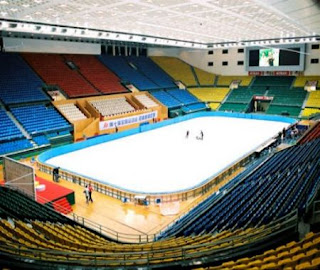 The renovation project extended the CIS's life by 30 years. Now, the structure is capable of enduring an earthquake measuring eight on the Richter scale, and has saved the country much money.
The CIS is friendly to people with disabilities, thanks to its newly-built handicap-accessible facilities, such as two lifts on its western side, an easy to use entrance and enlarged toilets. Six boxes on its third floor, seating a total of 48 wheelchair users, are reserved for people with disabilities.
"All the floor planks here were imported and manufactured according to the NBA requirements," project manager Yang Chunlin told the press.
Furthermore, there is a skating ground underneath the movable planks, chief engineer Han Fushi said.
The temperature of the CIS is required to remain between 18 and 28 grade Celsius to cater for winter and summer competitions. To solve the question of air conditioning, water coolants were used to replace ammonia and freon for the sake of ozone layer protection.
Built in 1968, the 18,000 seat stadium has been a comprehensive sport facility for table tennis, badminton, volleyball, basketball and gymnastics competitions, in addition to skating and ice hockey sports. In 2001, it was renovated to become a venue for the World University Games, while the latest expansion to an area of 54,707 sq m follows international standards, giving it many more functions to meet Olympic requirements.
The competition court, training courts and Games-time functional rooms were all renovated, with the ticket counter and registration center built from scratch.

The CIS is friendly to people with disabilities, thanks to its newly-built handicap-accessible facilities, such as two lifts on its western side, an easy to use entrance and enlarged toilets. Six boxes on its third floor, seating a total of 48 wheelchair users, are reserved for people with disabilities.
"All the floor planks here were imported and manufactured according to the NBA requirements," project manager Yang Chunlin told the press.
Furthermore, there is a skating ground underneath the movable planks, chief engineer Han Fushi said.
The temperature of the CIS is required to remain between 18 and 28 grade Celsius to cater for winter and summer competitions. To solve the question of air conditioning, water coolants were used to replace ammonia and freon for the sake of ozone layer protection.
Sunday, July 28, 2013
Guilin never ceases to amaze
The most enchanting sights in China are said to be Shanghai at night, Beijing in autumn, Chongqing in fog and Guilin in the rain. I headed to Guilin, which means forest of sweet osmanthus, two weeks ago and was awed by the rain and mist-shrouded peaks in this world-famous site in the Guangxi Zhuang Autonomous Region.
I could appreciate the sentiments of Wang Zhengong, a poet in the Song Dynasty (960-1279) who carved on the Solitary Beauty Peak: "No landscape on Earth equals Guilin in beauty."
The flight from Shanghai takes around two and a half hours and when arriving I immediately smelled the sweet osmanthus trees that grow everywhere in the city. The red lanterns from the Chinese Lunar New Year are still hanging in the trees.
The famous boat cruise on the winding Lijiang River passes the many karst mountains and peaks, some with bizarre shapes that resemble an elephant sipping water, a walking camel and an old man lost in thought.
 The rain and fog above the river lend an air of mystery. When the river takes a big turn at Xingping Old Town, I saw the familiar and heart-stopping beauty that is engraved on the 20-yuan Chinese bank notes. Fishermen float by on bamboo rafts with their "leashed" cormorants that dive for fish. Every morning they sell fish, shrimp and crabs to cruise boats.
In addition to natural scenery, the slow-paced city is rich in history and culture. The Sun and Moon pagodas on Banyan Lake reflect a balance of yin and yang, two fundamentals of Chinese philosophy.
The nine-story shining Sun Pagoda is covered in copper and is the world's tallest copper pagoda. The silvery Moon Pagoda is a seven-story tower of glass. They complement each other and suggest that the interaction of yin and yang gives rise to everything in the universe.
Royal compound
The Jingjiang Prince's Palace is considered the most auspicious place in Guilin. Built from 1372 to 1392 in the Ming Dynasty (1368-1644), the royal complex was the official residence of Zhu Shouqian, great-nephew of Zhu Yuanzhang, the first emperor of the Ming Dynasty.
In the 257 years from construction to the end of the Ming Dynasty, 14 princes from 12 generations lived there. It was also the base camp for revolutionary and political leader Sun Yat-sen during the Northern Expedition in 1921.
Xiang yun or "auspicious clouds" are carved on the entrance gate and delicately carved balustrades and marble steps are well preserved.
The building satisfies the basic requirements of feng shui - it is south of a hill (Solitary Beauty Peak) and north of a river (Lijiang River). In the garden, tree branches take the shape of a dragon's claw. On the southern stone face of the mountain is a giant inscription of the Chinese character shou (longevity) written by the Qing Dynasty (1644-1911) Empress Dowager Cixi.
Inside Peace Cave at the foot of the peak, the wall is carved with the images of 60 Chinese gods of the zodiac. According to the zodiac, 60 gods take their turns to be Tai Sui (Grand Duke of Jupiter) every year and each has characteristics that astrologers compare with people's zodiac animals.
I could appreciate the sentiments of Wang Zhengong, a poet in the Song Dynasty (960-1279) who carved on the Solitary Beauty Peak: "No landscape on Earth equals Guilin in beauty."
The flight from Shanghai takes around two and a half hours and when arriving I immediately smelled the sweet osmanthus trees that grow everywhere in the city. The red lanterns from the Chinese Lunar New Year are still hanging in the trees.
The famous boat cruise on the winding Lijiang River passes the many karst mountains and peaks, some with bizarre shapes that resemble an elephant sipping water, a walking camel and an old man lost in thought.
In addition to natural scenery, the slow-paced city is rich in history and culture. The Sun and Moon pagodas on Banyan Lake reflect a balance of yin and yang, two fundamentals of Chinese philosophy.
The nine-story shining Sun Pagoda is covered in copper and is the world's tallest copper pagoda. The silvery Moon Pagoda is a seven-story tower of glass. They complement each other and suggest that the interaction of yin and yang gives rise to everything in the universe.
Royal compound
The Jingjiang Prince's Palace is considered the most auspicious place in Guilin. Built from 1372 to 1392 in the Ming Dynasty (1368-1644), the royal complex was the official residence of Zhu Shouqian, great-nephew of Zhu Yuanzhang, the first emperor of the Ming Dynasty.
In the 257 years from construction to the end of the Ming Dynasty, 14 princes from 12 generations lived there. It was also the base camp for revolutionary and political leader Sun Yat-sen during the Northern Expedition in 1921.
Xiang yun or "auspicious clouds" are carved on the entrance gate and delicately carved balustrades and marble steps are well preserved.
The building satisfies the basic requirements of feng shui - it is south of a hill (Solitary Beauty Peak) and north of a river (Lijiang River). In the garden, tree branches take the shape of a dragon's claw. On the southern stone face of the mountain is a giant inscription of the Chinese character shou (longevity) written by the Qing Dynasty (1644-1911) Empress Dowager Cixi.
Inside Peace Cave at the foot of the peak, the wall is carved with the images of 60 Chinese gods of the zodiac. According to the zodiac, 60 gods take their turns to be Tai Sui (Grand Duke of Jupiter) every year and each has characteristics that astrologers compare with people's zodiac animals.
Sunday, July 21, 2013
China Landscapes Chapter Qingdao
An actor and an actress perform at Qingdao Underwater World in Qingdao, east China's Shandong
 Province, Feb. 15, 2013. During the Spring Festival holidays, an underwater performance telling the story of a mermaid and a prince attracted many visitors in Qingdao. Visual, audio and electronical technologies were applied to the performance.

Subscribe to:
Posts (Atom)